
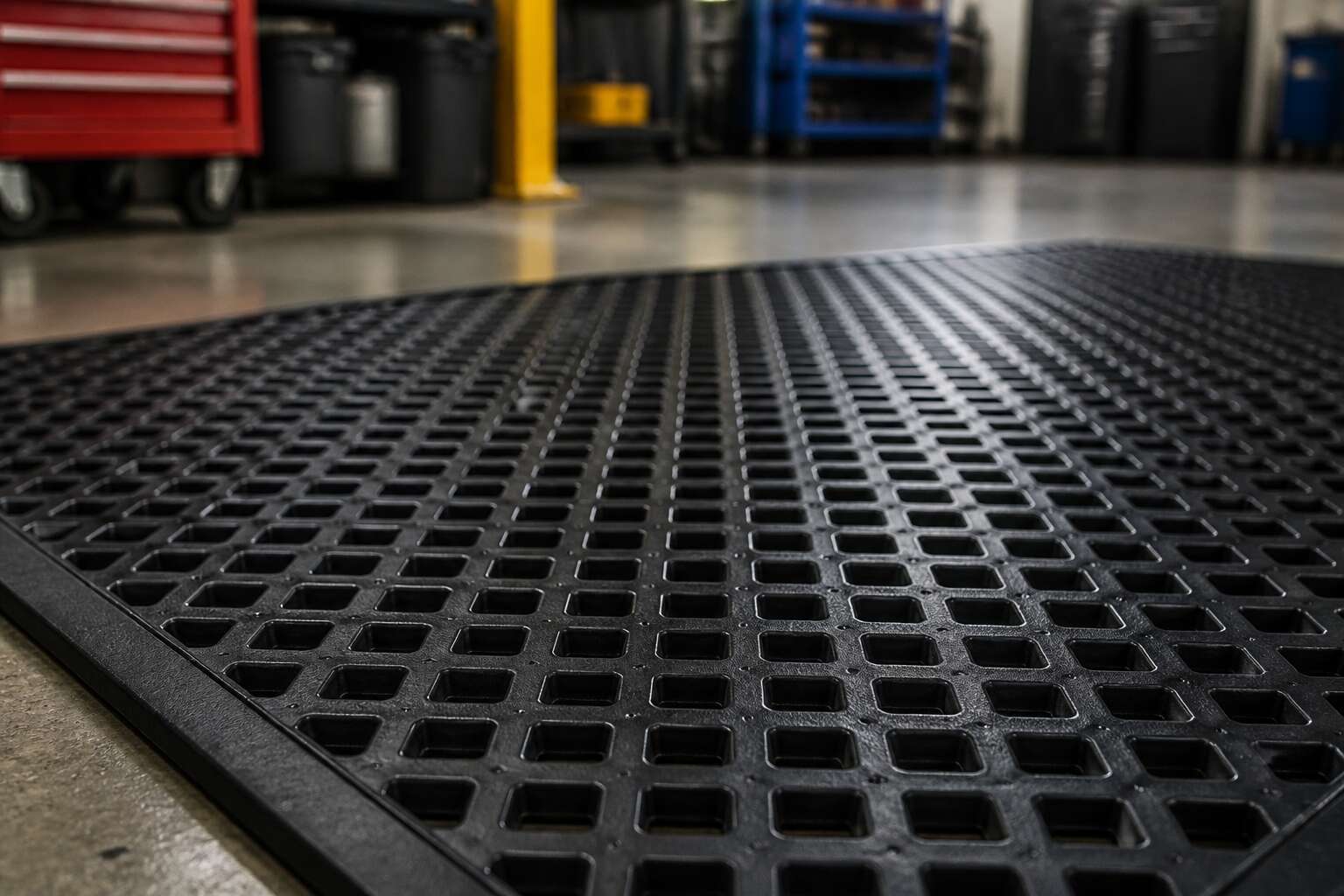
Why Choose Rubber Floor Mats with Holes
Drainage and Airflow Benefits
On the South African Highveld, an afternoon thunderstorm can turn a garage floor into a hazard within minutes. Rubber floor mats with holes solve this by letting water pass through immediately instead of pooling on the surface.
Airflow performs an equally important function beneath the mat. Trapped moisture encourages mildew growth, especially in coastal towns like Durban where humidity hangs in the air. The perforations allow air to circulate, keeping the underside dry and limiting the odours that cling to rubber over time.
- Water drains faster during heavy downpours
- Underlying concrete stays visible so you can spot oil leaks early
Rubber floor mats with holes also protect your vehicle’s carpet or your workshop floor from staining. South Africans who use bakkies for work and leisure will appreciate a surface that dries quickly and remains comfortable underfoot.
Slip Resistance and Traction
Slip resistance is where rubber floor mats with holes prove their worth. After a Highveld downpour, your boots carry water, oil, and mud across every smooth surface. The patterned surface grips your soles from the moment you step on them. It works in reverse as well; the perforations create a partial vacuum when compressed, anchoring the mat to the concrete. Your feet stay planted, and your bakkie’s tyres get a consistent surface when you drive in and out.
A mat that shifts underfoot is worse than no mat. The design prevents that:
- Raised knobs and ribs make contact with your shoe at multiple points
- The holes allow the mat to conform to uneven concrete
- The rubber compound provides inherent grip, even with soaked soles
That combination makes rubber floor mats with holes the safer choice for any South African garage, workshop, or loading bay.
Dirt and Debris Containment
A heavy week of work deposits hundreds of grams of grit per square metre across a workshop floor. The perforations in rubber floor mats with holes capture that grit before it travels further. Sand, stone dust, and metal filings drop into the holes and settle below the walking surface. They stay there until you lift the mat for cleaning. Trapped debris no longer grinds into sealed concrete or follows your heels through the office doorway.
A typical garage mat intercepts this load during a single shift:
- Swept-in Highveld dust and fine red sand
- Metal shavings from a grinder or lathe
- Chipped concrete and soil carried in tyre treads
A continuous mat pushes material ahead of its surface and spreads the problem. Rubber floor mats with holes hold the material in one place. Lift one at the end of the month and the evidence of every dirty boot appears before you.
Versatility Across Indoor and Outdoor Spaces
From a factory reception desk to a farm loading bay, the same surface must perform differently. Rubber floor mats with holes adapt to both environments. They cushion a standing worker during a long shift and endure harsh sunlight on an exposed stoep.
Consider the line between workshop and garden. These mats hold up on gravel pathways and polished concrete alike. A garage floor gains protection from heavy equipment. A covered patio gains a comfortable, solid walking surface.
- Place them at an industrial entrance for daily foot traffic
- Lay them on a balcony to create a solid platform
- Use them in a kennel to separate animals from cold floors
The uniform pattern works in any direction. I have seen one mat serve a welding bay and a weekend braai area without complaint!
Key Applications and Use Cases
Automotive and Garage Flooring
Each year, South African mechanics handle thousands of oil changes, each one a potential hazard. For home workshops and commercial garages, rubber floor mats with holes offer a solid foundation. The thick rubber cushions dropped tools and absorbs the weight of engines and transmissions.
Consider the daily routine in a typical automotive bay. A vehicle sits on a lift, and the concrete around it bears constant pressure. These mats protect that surface from cracks caused by hydraulic jacks and steel workbenches. They also create a stable zone for kneeling during brake and suspension work.
- Placing mats under the engine bay during repairs
- Lining the walking path between workbenches
- Using them in trailer and caravan storage areas
For South African conditions, where dust and heat are common, these mats hold up well and rinse clean with a hose.
Industrial and Commercial Work Areas
Accidents in industrial work areas cost South African businesses millions each year in lost production and claims. Much of that cost begins with a hard, unforgiving floor. Rubber floor mats with holes serve a simpler purpose in factories and warehouses. They place a stable, shock absorbing layer between employees and concrete.
Consider the crew standing eight hours at a packaging line. Concrete wears down knees and backs faster than any machine. The perforated design lets the mat flex under repeated stress without cracking. That is why plant managers in Durban and Johannesburg specify rubber floor mats with holes for their walkways and workstation pads. I have seen the difference it makes on a busy production floor.
Common industrial placements include:
– Areas where spillage is routine
– Loading docks and equipment bays
– Machine operator stations
These mats also absorb vibration from presses and compressors. Workers feel less fatigue, and the floor beneath stays intact. For a commercial facility, that is a small investment with measurable returns.
Outdoor Entryways and Mudrooms
Sweep a threshold in Johannesburg and you will meet the enemy: red dust, winter mud, the fine sand that migrates into every room. Rubber floor mats with holes stand between that mess and your home. They absorb the first impact so your floors never have to.
The mudroom is where the transition happens. Boots come off. Bags drop. Dogs shake off the rain. The mat catches whatever the family brings in, from coarse grit to wet grass. It holds the mess at the threshold, keeping it out of the hallway.
The daily rhythm of a South African household:
– Morning departures with wet grass from the sprinklers
– Midday returns carrying driveway dust
– Rainy evenings when everything comes in soaked
Rubber floor mats with holes flex under shifting loads. A loaded shopping bag, a heavy school bag, a child on a scooter. They spring back, season after season.
Marine and RV Environments
Salt spray, river silt, and the fine dust of the Karoo all find their way aboard a fishing boat or a caravan step. Rubber floor mats with holes become the tactical layer between that chaos and the cabin floor. The perforations clear water instantly, leaving the surface clean enough for bare feet.
RV owners know the routine: stepping out onto wet grass, then stepping back onto a pristine interior. The mat at the door handles this transition without complaint. These are the moments it is made for:
- Coming off a mooring onto a slippery transom.
- Shaking out a dusty blanket over the caravan step.
- Crossing from a wet beach to a dry cockpit.
The material stands up to UV rays and the humid, corrosive air of the coast. These rubber floor mats with holes will not rust or splinter, and they shrug off the type of salt crust that destroys other surfaces. For the weekend explorer or the full-time liveaboard, it is a simple installation that keeps every journey dry and stable.
Agricultural and Equestrian Facilities
In a dairy parlour or a horse stall, rubber floor mats with holes do the unglamorous work of keeping hooves out of slurry. The perforations let urine and washdown water drain away, which means less ammonia, less slippery film, and fewer vet visits. Concrete underneath stays cleaner and lasts longer.
- Milking parlour platforms
- Grooming and wash bays
- Feed alleys and stable aisles
Equestrian facilities use them under saddle racks and around water troughs. Agricultural setups place them in feeding lanes and holding pens. The mats take the brunt of shod hooves, dropped tools, and the occasional tantrum. They also cushion tired joints when animals lie down.
Material Considerations and Durability
Rubber Composition and Thickness
The quiet persistence of a well made rubber mat is easy to overlook. Yet a single mat can absorb decades of footfalls and equipment drops. In South Africa’s harsh sun and sudden downpours, the material’s constitution becomes the true measure of worth.
Rubber floor mats with holes rely on compound blends that resist cracking and fading. Natural rubber offers elasticity, while synthetic polymers add resilience against oils and chemicals. I have seen cheap mats turn brittle within a year, their edges crumbling like dried clay. That failure comes from inadequate curing or recycled fillers.
– Vulcanised rubber handles temperature extremes without warping
– Additives like carbon black shield against UV degradation
– Higher density prevents the surface from tearing under sharp objects
Thickness dictates load bearing capacity. A 10 mm mat suits light foot traffic. For workshop benches or stable floors, I recommend 15 mm or more. The perforations weaken structural integrity slightly, so thicker profiles compensate. Measure your heaviest expected weight, then add a margin. Nothing ruins a floor faster than a mat that compresses into uselessness overnight.
Perforation Patterns and Hole Sizes
The geometry of perforation is a quiet negotiation between drainage efficiency and structural honesty. Every hole in a rubber floor mat with holes creates a stress concentration point. Under repeated compression, the edges of those voids can become initiation sites for tears. This is where material considerations and durability converge. A mat with large, widely spaced holes may shed water quickly, but it offers less surface area to distribute load. Conversely, smaller holes spaced closely provide better support but can clog with debris over time. The optimal pattern depends on the expected abuse. For heavy rolling loads, oval holes oriented parallel to the direction of travel reduce edge strain. For static weights, circular holes suffice.
I have seen mats fail not because of poor rubber, but because the perforation pattern ignored how forces travel through the sheet. The edge radius of each hole matters. Sharp cut edges concentrate stress; moulded or chamfered edges dissipate it. Vulcanised rubber handles this better than recycled blends, which often have inconsistent internal stress. In South Africa, where floors face both searing heat and sudden cold, the contraction rate of the rubber must align with the hole geometry. A mismatch leads to cracking around the perforations.
- Edge radius of each hole, which determines tear resistance
- Spacing ratio between holes, affecting load distribution
- Thickness-to-hole-diameter ratio, governing flexural strength
The durability of rubber floor mats with holes is not a function of material alone. It is an equation where every void negotiates for space within the whole. The right pattern makes a mat outlast its expected life.
Weather Resistance and UV Stability
The sun performs its damage without a single warning. UV radiation breaks down the polymer bonds in rubber floor mats with holes, turning supple sheets brittle over years of South African exposure. I have lifted mats from factory floors that crumbled at the edges while the centres remained intact, a strange and quiet unevenness.
Weather resistance depends on additives: antiozonants, carbon black, UV stabilisers. Without them, the material loses elasticity and the holes become fracture points under thermal cycling. Consider the local climate:
- Highland frost stresses the rubber matrix daily.
- Coastal salt air accelerates oxidation.
- Inland UV intensity degrades unprotected surfaces.
Rubber floor mats with holes must hold their shape through this assault, and the best compounds are formulated to do exactly that.
Weight, Flexibility, and Handling
The weight of rubber floor mats with holes is the first truth you feel. A dense sheet tells you it will endure, while a lighter mat flexes easily but compresses under load. The flexibility is a trade-off. I have struggled with sheets that flipped at the edges because the compound was too lively. The best mats hold a middle ground. They bend for installation and straighten out once laid.
Handling changes with the seasons. A mat that rolls easily in February turns stiff on a frosty Johannesburg morning. The compound needs to offer give without sacrificing structural integrity. On a factory floor, the weight helps the sheet resist curling at the edges. Consider the physical properties:
- The rubber’s density determines how well it absorbs impact.
- The tear resistance of the holes keeps the pattern intact.
- The grip of the surface affects how it slides across concrete.
These properties decide if a mat is a pleasure to install or a battle. The right rubber floor mats with holes feel steady, not stubborn.
Load Bearing Capacity and Impact Absorption
The rubber compound determines whether a mat survives a decade or crumbles in three years. I have watched cheap sheets turn brittle and crack under constant weight. Quality rubber floor mats with holes use virgin compounds, not regrind, which hold elasticity far longer.
Load bearing capacity depends on thickness and density. A 10mm mat handles a forklift’s weight. A 5mm mat does not. The perforations help distribute pressure across the sheet. They let the rubber flex under load without tearing.
Three properties matter:
- Compression set: the mat must return to shape after the weight lifts.
- Tensile strength: how much pulling the material endures before ripping.
- Shore hardness: 70 to 80 durometer suits heavy duty settings.
Impact absorption works because rubber stores kinetic energy and releases it slowly. That protects a dropped toolbox and the concrete beneath. Rubber floor mats with holes absorb that shock instead of bouncing it back.
Installation and Maintenance Best Practices
Preparing the Subfloor Surface
According to facility managers, roughly 70% of flooring failures trace back to inadequate surface preparation. That statistic always lingers in my mind when I approach a new installation. The ground beneath rubber floor mats with holes demands respect, not guesswork. Sweep away loose debris, fill every crack, and verify the surface slopes properly for water runoff. I test moisture levels before laying a single mat, because trapped humidity creates hidden problems.
- Remove grease and oil using a degreaser
- Patch low spots with a cementitious leveler
- Allow at least 24 hours for complete curing
Maintenance follows the same logic. Rinse the mats regularly to stop dirt from clogging the perforations. A stiff broom works wonders on textured surfaces. Avoid harsh solvents, which can break down rubber fibers over time. Inspect the edges seasonally, catching any curling before it becomes a trip hazard. These habits keep your investment performing year after year without fuss.
Cutting, Trimming, and Fitting Mats
Cutting, trimming, and fitting rubber floor mats with holes is where precision meets patience. A sharp utility knife and a straightedge beat any scissors. Mark cuts on the underside with chalk. For curved edges around posts or drains, make a cardboard template first. This saves material.
- Measure twice, allowing a 5 mm expansion gap.
- Score the mat firmly along the line, then bend and snap.
- Test fit before final trimming.
Each cut changes structural integrity, so leave factory edges intact whenever possible. For interlocking tiles, trim the tongue and groove carefully to maintain alignment. A jigsaw with a fine blade works well for thicker rubber floor mats with holes, but keep the speed low to prevent melting. Fit them loosely at first. Rubber expands under heat, and compression from walls can cause buckling.
Cleaning Techniques for Perforated Mats
Proper installation matters, but long term performance depends on how you maintain the surface. Rubber floor mats with holes collect less standing debris than solid sheets, yet they still demand a deliberate cleaning rhythm. Begin with a stiff broom or compressed air to push grit out of the perforations. Then rinse using a hose and a pH neutral soap, scrubbing with a soft deck brush. For caked mud, a pressure washer on a gentle setting works, though keep the nozzle at a safe distance to protect the mat’s edges.
- Sweep or vacuum weekly to keep the holes clear.
- Deep clean monthly with warm water and mild detergent.
- Dry the mats completely before reinstalling.
Moisture trapped beneath the rubber can damage the subfloor and invite mildew. In South Africa’s harsh sunshine, rotate the mats every few months to avoid uneven ultraviolet wear. A diluted vinegar rinse helps remove mineral stains near pools or coastal properties. Consistent attention to these routines extends the life of rubber floor mats with holes and keeps the surface safe underfoot.
Preventing Mold, Mildew, and Odors
The smell of a garage is seldom the car. It is the damp rubber lying flat against the concrete, holding moisture close. Rubber floor mats with holes reduce this risk, but only when installation respects the flow of water and air. Elevate the mats slightly with drainage spacers, allowing the perforations to do their work.
Odour prevention starts at the subfloor. Vapour barriers, sloped bases, and small gaps between mats all encourage drainage and airflow. In coastal regions of South Africa, where humidity sits high, these details matter more than the mat itself.
- Leave a 5 to 10 millimetre gap between mats for air movement
- Use a sloped subfloor base where possible
- Install a vapour barrier beneath mats on concrete slabs
For rubber floor mats with holes, a dry underside is the difference between years of service and premature replacement.
Spotting Wear and Determining Replacement
Installation determines the lifespan of rubber floor mats with holes. In Durban’s humidity, mats laid directly on damp concrete will fail within months. Leave them to acclimate for 24 hours before fitting, and allow a small perimeter gap for expansion.
Routine maintenance follows installation. Sweep the perforations weekly to keep debris from compacting into the holes. Monthly, lift the mats and wipe the subfloor with a mildewcide solution. This preserves drainage and keeps the underside dry!
Rubber floor mats with holes wear gradually, but the perforations are usually where damage starts. Check for cracks radiating from the hole edges, flattened areas that feel slick, or curled corners that create tripping hazards.
Check these signs every few months:
– Cracks growing outward from holes
– Loss of surface texture
– Sharp edges where the mat has torn
At this point, the mat has exceeded its useful life, and continued use invites slips and subfloor damage.
0 Comments