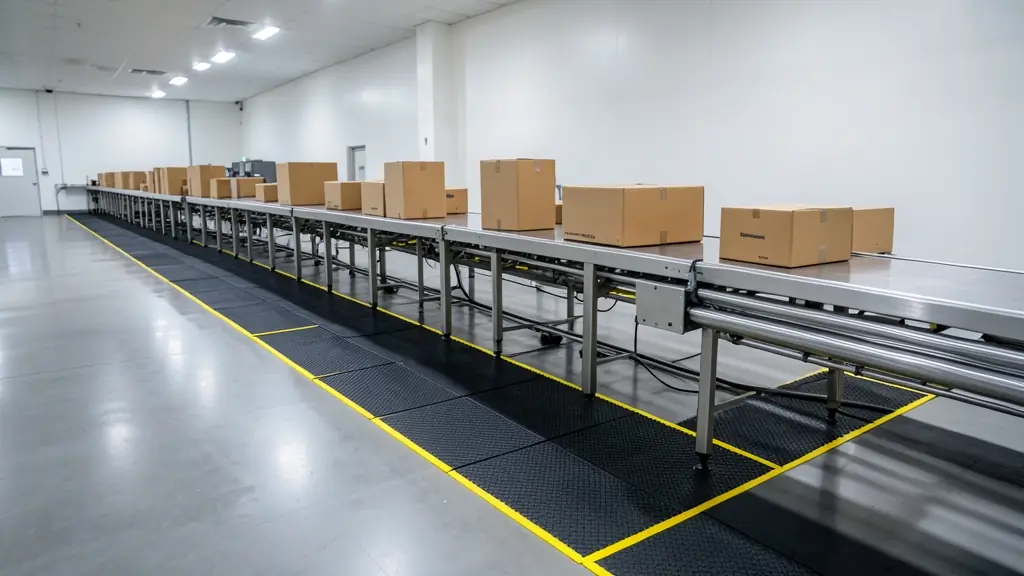
Anti-fatigue mats are cushioned mats for people who stand in one spot for hours: packers, till operators, machinists, cooks, hairdressers and theatre staff. A slight give underfoot encourages small movements in the legs and takes the edge off a hard concrete floor, and many people find long shifts less tiring on them. The right mat depends on whether the floor is dry, wet or oily, and on what rolls or drops onto it. This page explains the kinds, the edges and the regulations. Send one request and mat suppliers in your area quote you directly.
Why employers put them down
The Ergonomics Regulations, 2019, made under the Occupational Health and Safety Act, 85 of 1993, require employers to assess ergonomic risk in the workplace and reduce it. Prolonged standing is one of the risks such an assessment looks at, and anti-fatigue mats are a common, low-cost measure, alongside job rotation, sit-stand stools and good footwear. The regulations do not name mats as a must; your assessment decides what fits. A mat also protects dropped tools and parts, and quietens a noisy steel or concrete floor.
Choose by the conditions
- Dry areas (tills, assembly benches, offices with standing desks): a solid cushioned mat with a smooth or lightly textured top.
- Wet areas (kitchens, food processing, washing lines): a mat with drainage holes that keeps feet above the water.
- Oily areas (machining, engine shops, fryers): a nitrile rubber mat that resists oil and grease.
- Electronics: an anti-static mat where static could damage parts; ask about the rating.
- Long lines: interlocking mats that join to any length.
Edges, thickness and trolleys
A good anti-fatigue mat has bevelled edges, often in yellow on the open sides so people see the step. Thickness is commonly somewhere around 10 to 25 mm; thicker is not always better, because a mat that is too soft makes people sway. Trolleys and pallet jacks need firm mats or ramps, or they will tear the edges. Where heavy machines sit rather than people stand, look at heavy-duty rubber mats; for slippery floors generally, non-slip rubber matting.
Keeping mats safe
Check mats for curled corners, tears and worn edges: a damaged mat becomes a trip hazard. Lift and clean underneath regularly, because swarf, food and water collect there. Wash with a pH-neutral cleaner, hose drainage mats outside and let them dry before laying them back. Replace mats that have gone flat and hard; they no longer do the job. Ask the people who use the mats how they find them after a week or two: comfort is personal, and a short trial of two types before a large order often saves money.
What to put in your request
- How many workstations and the standing area at each
- Whether the floor is dry, wet or oily
- Whether trolleys or pallet jacks cross the mats
- Any need for anti-static mats
- Single mats or one long interlocking run
Anti-Fatigue Mats for gyms, schools, homes, industry and farms
- Gyms and fitness studios: cushioned mats behind reception desks and at smoothie bars
- Schools, crèches and play areas: mats at kitchen serving lines and in technical workshop classrooms
- Homeowners: a mat in front of the kitchen sink, a workbench or a standing desk
- Factories, mines and plants: mats along packing lines, assembly benches and machine stations
- Shops, offices and entrances: mats behind tills, at service counters and in salons
- Hotels, lodges and restaurants: drained mats on kitchen lines, at dish wash stations and behind bars
- Municipalities, parks and sports clubs: mats at licensing counters, clinic dispensaries and depot workshops
- Hospitals, clinics and care homes: mats in theatres, pharmacies, laboratories and sterilising rooms
- Farms, stables and dairies: drained mats at packhouse grading tables and milking parlour pits
Frequently asked questions
Do you supply anti-fatigue mats yourselves?
Are anti-fatigue mats required by law in South Africa?
Can I use an anti-fatigue mat in a commercial kitchen?
How long does an anti-fatigue mat last?
Anti-Fatigue Mats by province and city
- Johannesburg
- Pretoria
- Centurion
- Midrand
- Sandton
- Randburg
- Roodepoort
- Krugersdorp
- Randfontein
- Germiston
- Boksburg
- Benoni
- Kempton Park
- Alberton
- Vanderbijlpark
- Vereeniging
- Durban
- Pinetown
- Pietermaritzburg
- Richards Bay
- Newcastle
- Ladysmith
- Gqeberha (Port Elizabeth)
- East London
- Kariega (Uitenhage)
- Mthatha
- Cape Town
- Bellville
- Paarl
- Stellenbosch
- George
- Worcester
- eMalahleni (Witbank)
- Middelburg
- Secunda
- Mbombela (Nelspruit)
- Rustenburg
- Brits
- Klerksdorp
- Potchefstroom
- Mahikeng
- Polokwane
- Tzaneen
- Kimberley
- Upington
- Bloemfontein
- Welkom
- Sasolburg