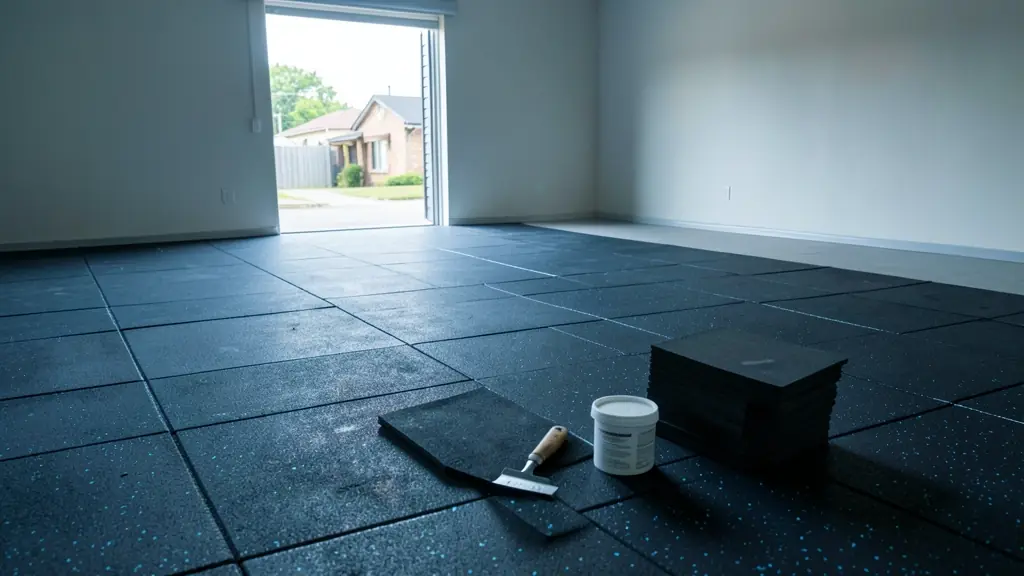
Good rubber can still make a bad floor. Edges curl, tiles creep apart, glue lets go and dips show through, and nearly every time the cause is the base or the preparation, not the rubber. Rubber flooring installation follows the same order on every job: survey, base preparation, acclimatising, setting out, fixing, cutting, edging, curing and handover. This page walks through each step, indoors and outdoors, and helps you decide between DIY and an installer. Send one request and independent installers who work in your area quote you directly.
Survey and base preparation
The base must be firm, level, clean and dry. Indoors, the installer checks the slab or screed for cracks, hollow spots, dust, paint and old glue, and for moisture: rubber laid on a damp slab can trap water, and PU glue may fail. High and low spots are ground down or filled with a levelling screed. Outdoors, the base needs a fall and drainage: concrete, sound paving or compacted crusher run, never loose soil. That answers the common question about laying tiles on dirt: build a compacted base first.
Acclimatise and set out
Rubber moves with temperature, so tiles and rolls should sit in the room, unpacked, for the time the maker gives before laying. Then the installer snaps a straight line, usually from the centre or the most visible wall, so the cut tiles land at the edges, and dry lays a row to check the joints. Tiles from different batches can differ in colour, so mix boxes as you go. Allow extra for cuts, often 5 to 10 percent of the area. Around doors, drains and columns, make a paper or card template first: it is cheaper to ruin cardboard than a tile.
Loose lay, glue or pin
There are three ways to hold a floor:
- Loose lay: heavy or interlocking tiles in a home gym or play room, easy to lift later.
- Glue: a PU adhesive spread with a notched trowel, for commercial gyms, wheeled traffic and outdoor tiles (see rubber flooring adhesive).
- Pins or dowels: tiles pinned to each other, common on playgrounds and patios.
Cuts are made with a sharp knife or blade against a straight edge.
Edges, curing and handover
Every exposed edge needs a ramp or bevelled edging strip, or a kerb outdoors, so nobody trips and nothing catches. Leave expansion space where the maker says. Glued floors need curing time before heavy equipment goes back on; ask the installer how long, as it depends on temperature and humidity. At handover, ask for the cleaning instructions, a box of spare tiles from the same batch and the product and test documents. Cleaning and later fixes are covered on rubber floor repairs.
What to put in your request
- The area in m², indoors or outdoors
- The base: slab, screed, old tiles, paving or soil
- Whether you have the tiles or rolls, or need them supplied
- Loose lay, glue or pins, if you know
- Edges and doorways that need ramps or edging
Rubber Flooring Installation for gyms, schools, homes, industry and farms
- Gyms and fitness studios: a commercial gym floor glued down on a levelled screed, drop zones laid thicker
- Schools, crèches and play areas: playground tiles pinned on a drained base under a new jungle gym
- Homeowners: a garage gym or patio laid on a checked base with proper edging
- Factories, mines and plants: rubber walkways and canteen floors laid over a repaired factory slab
- Shops, offices and entrances: a showroom or office gym laid over a weekend with ramps at the doors
- Hotels, lodges and restaurants: pool surrounds and hotel gyms laid with glue and edge strips
- Municipalities, parks and sports clubs: park playgrounds and community halls installed to the maker's method
- Hospitals, clinics and care homes: rehab and physio floors glued with tight joints and flush thresholds
- Farms, stables and dairies: stable floors and wash bays laid tight on a firm, drained base
Frequently asked questions
Can I install rubber tiles myself?
How do I install rubber tiles outdoors?
Can rubber tiles go over existing tiles or vinyl?
Do you install rubber flooring yourselves?
Rubber Flooring Installation by province and city
- Johannesburg
- Pretoria
- Centurion
- Midrand
- Sandton
- Randburg
- Roodepoort
- Krugersdorp
- Randfontein
- Germiston
- Boksburg
- Benoni
- Kempton Park
- Alberton
- Vanderbijlpark
- Vereeniging
- Durban
- Pinetown
- Pietermaritzburg
- Richards Bay
- Newcastle
- Ladysmith
- Gqeberha (Port Elizabeth)
- East London
- Kariega (Uitenhage)
- Mthatha
- Cape Town
- Bellville
- Paarl
- Stellenbosch
- George
- Worcester
- eMalahleni (Witbank)
- Middelburg
- Secunda
- Mbombela (Nelspruit)
- Rustenburg
- Brits
- Klerksdorp
- Potchefstroom
- Mahikeng
- Polokwane
- Tzaneen
- Kimberley
- Upington
- Bloemfontein
- Welkom
- Sasolburg