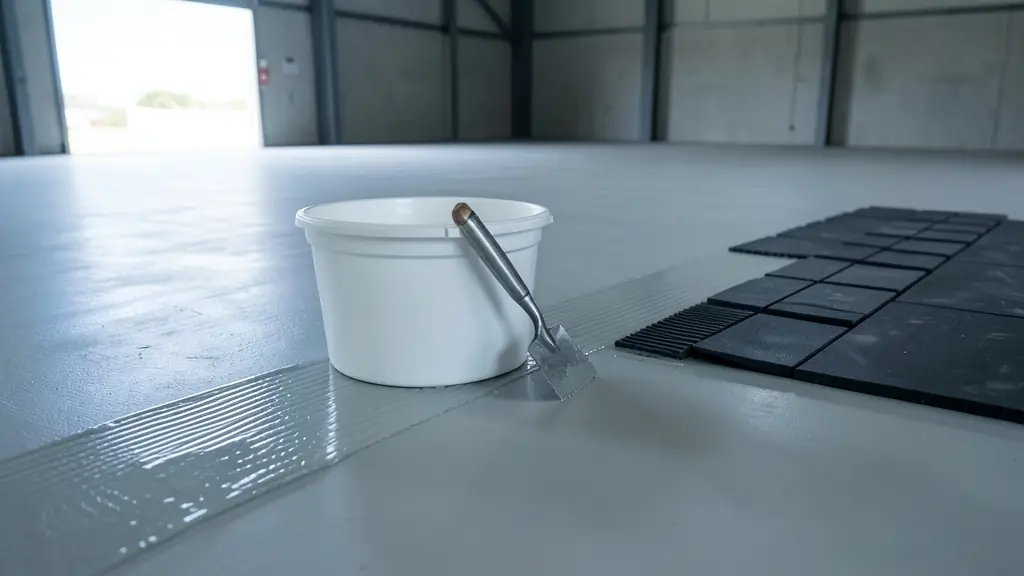
Most glued rubber floors that fail were glued with the wrong product, too little of it, or onto a damp or dusty base. Rubber flooring glue is usually a one-part or two-part polyurethane (PU) adhesive, chosen to suit the rubber, the base and whether the floor is indoors or out. Poured surfaces and crumb products use a related product, PU binder. This page explains the kinds, how much you need, the conditions they need and what to avoid. Send one request and independent suppliers and installers who work in your area quote you directly.
PU adhesive, contact adhesive and binder
- One-part PU adhesive cures with moisture from the air. It is simple to use and common for rubber tiles and rolls.
- Two-part PU adhesive is mixed from a resin and a hardener just before use. It cures more predictably, suits outdoor and heavy-traffic floors, and must be used within its pot life.
- Contact adhesive is used for some sheet jobs, such as stair treads and vehicle floors.
- PU binder is a liquid that bonds rubber crumb into wetpour and repairs.
Use the adhesive the rubber maker recommends.
How much glue you need
Adhesive is spread with a notched trowel, and the notch size sets how much goes down. The maker gives a coverage rate per m² for each base and product; follow it, because a thin spread leaves hollow spots and a heavy one squeezes up through joints. Rough or porous bases take more. Work out the area to glue, add the maker's rate and a little extra for waste, and order enough from one batch. Thicker rubber does not always need more glue, but rough backs often do. Check the use-by date on each tub as well: old adhesive can thicken in the container and spread badly.
Temperature, open time and ventilation
Every adhesive has an open time (how long it stays workable after spreading) and a cure time, and both change with temperature and humidity. A hot Lowveld afternoon shortens the open time; a cold Highveld winter morning or a damp coastal day slows the cure. Lay only as much glue as you can cover in time, roll or weigh the rubber down as the maker says, and keep traffic off until it has cured. Ventilate the room: open doors, avoid flames, and read the safety data sheet.
What not to use, and sealers
Avoid general solvent glues and building adhesives unless the rubber maker approves them: some solvents attack rubber and make it swell or crack. Tile cement and silicone are not substitutes for a proper adhesive. After laying, some rubber floors take a sealer or floor dressing that eases cleaning, but not all do; ask the maker first. The full laying sequence is on rubber flooring installation, and re-gluing loose edges on rubber floor repairs.
What to put in your request
- The area to glue in m²
- The rubber: tiles, rolls or sheeting, and the thickness
- The base: concrete, screed, timber, metal or old tiles
- Indoors or outdoors, and any wheeled loads
- Adhesive only, or supply and lay
Rubber Flooring Adhesive and Binder for gyms, schools, homes, industry and farms
- Gyms and fitness studios: two-part PU adhesive under commercial gym tiles so they never creep
- Schools, crèches and play areas: glue for a school hall floor and binder for patching the playground
- Homeowners: a few tubs of PU glue for a garage gym or a pool surround
- Factories, mines and plants: adhesive for rubber walkways and sheeting on a factory slab
- Shops, offices and entrances: glue for a showroom or office gym laid over a weekend
- Hotels, lodges and restaurants: PU adhesive for outdoor tiles around a hotel pool
- Municipalities, parks and sports clubs: PU binder for wetpour repairs in park playgrounds
- Hospitals, clinics and care homes: adhesive for rehab and physio room floors with tight joints
- Farms, stables and dairies: contact adhesive for sheeting in a horse float or trailer
Frequently asked questions
What is the best glue for rubber tiles?
Do I need to glue rubber gym tiles down?
Can I glue rubber flooring onto a timber floor?
Do you sell rubber flooring glue?
Rubber Flooring Adhesive and Binder by province and city
- Johannesburg
- Pretoria
- Centurion
- Midrand
- Sandton
- Randburg
- Roodepoort
- Krugersdorp
- Randfontein
- Germiston
- Boksburg
- Benoni
- Kempton Park
- Alberton
- Vanderbijlpark
- Vereeniging
- Durban
- Pinetown
- Pietermaritzburg
- Richards Bay
- Newcastle
- Ladysmith
- Gqeberha (Port Elizabeth)
- East London
- Kariega (Uitenhage)
- Mthatha
- Cape Town
- Bellville
- Paarl
- Stellenbosch
- George
- Worcester
- eMalahleni (Witbank)
- Middelburg
- Secunda
- Mbombela (Nelspruit)
- Rustenburg
- Brits
- Klerksdorp
- Potchefstroom
- Mahikeng
- Polokwane
- Tzaneen
- Kimberley
- Upington
- Bloemfontein
- Welkom
- Sasolburg