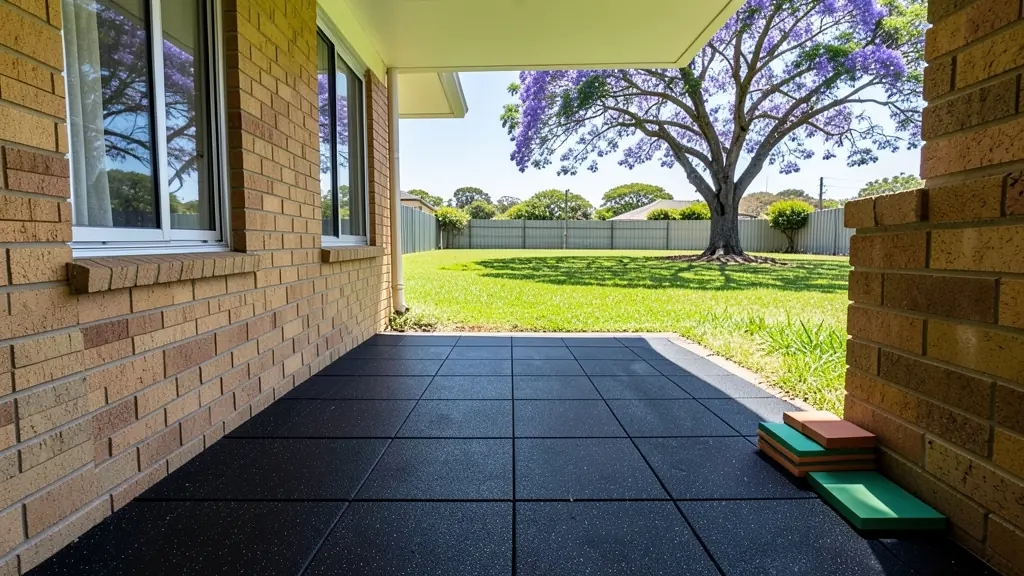
Rubber tiles are the hard-wearing, slightly soft floor you find in gyms, under jungle gyms, around pools and in garages all over South Africa. Most are pressed from recycled tyre crumb bound with polyurethane, often with a coloured top layer, and they give grip, absorb knocks, damp noise and can be hosed down. This page explains what rubber tiles are made of, the main kinds, the sizes and thickness to look for, how they are laid and what drives the price. Send one request and suppliers and installers near you quote you directly.
What rubber tiles are made of
Most tiles start as rubber crumb (SBR) from end-of-life tyres, recovered through South Africa's waste tyre recycling programme. The crumb is mixed with a polyurethane (PU) binder and pressed in moulds. Many tiles add a top layer of EPDM granules, a synthetic rubber that holds its colour in the sun far better than painted SBR. Some tiles are solid vulcanised rubber, denser and smoother. Black is the cheapest; blue, green, red and terracotta cost more. Some tiles are pressed in local factories and some are imported, so ask where yours come from and what the top layer is.
The main kinds
- Gym tiles: dense, and thicker in the drop zones under free weights.
- Playground tiles: impact-absorbing safety tiles tested for a critical fall height.
- Interlocking tiles: jigsaw edges, no glue, easy to lift and move.
- Outdoor tiles: patios, pool surrounds and braai areas on a drained base.
- Garage tiles: made to take car tyres and the odd oil drip.
Where tiles are not the answer, look at loose rubber mats or a joint-free poured EPDM surface.
Sizes, thickness and weight
Tiles of 500 x 500 mm and 1 x 1 m are common, with 1 x 0.5 m in some ranges. Thickness runs from about 10 mm for light indoor use, through 15 to 20 mm for general gym floors, to 30 to 40 mm or more for heavy weights and playgrounds, where the fall height sets it. The maker's sheet is the final word. Rubber is heavy: a 1 x 1 m tile 20 mm thick can weigh roughly 15 to 20 kg, so plan for a truck with a tail lift or a forklift, and for carrying. Order 5 to 10 percent over the area for cuts, plus ramps or edging, and keep a few spares from the same batch.
Laying and what drives the cost
The base must be firm, level, clean and dry, and tiles should acclimatise in the room before laying. They are loose laid, glued with a PU adhesive or pinned with dowels. Small indoor interlocking floors are often DIY; outdoor, playground and large jobs suit an installer (see rubber flooring installation). Price depends on the thickness, the top layer, tile size, quantity, edges and ramps, base preparation, glue, delivery and labour. When you compare quotes, compare the same thickness and top layer, or you are comparing different floors.
What to put in your request
- Where the tiles go: gym, play area, patio, garage or other
- The floor's length and width, or a rough sketch
- The thickness and tile size you have in mind
- Black or a coloured EPDM top layer
- Supply only, or supply and laying
Rubber Tiles for gyms, schools, homes, industry and farms
- Gyms and fitness studios: weight rooms and functional training floors, thicker under free weights and racks of plates
- Schools, crèches and play areas: safety tiles under jungle gyms and hard-wearing floors in sports rooms and aftercare spaces
- Homeowners: garage gyms, stoeps, pool surrounds and play corners that need grip and a soft landing
- Factories, mines and plants: workshop floors, canteens and walkways where people stand and things get dropped
- Shops, offices and entrances: entrances, showrooms and office gyms that need a quiet, non-slip floor
- Hotels, lodges and restaurants: pool decks, kids' play areas at restaurants and lodges, and back-of-house walkways
- Municipalities, parks and sports clubs: park playgrounds, community centre halls and outdoor gym stations
- Hospitals, clinics and care homes: rehab and physio rooms, care home walkways and clinic play corners
- Farms, stables and dairies: wash bays, packhouse walkways and farm stall play areas
Frequently asked questions
Do you sell or lay rubber tiles yourselves?
No. We run a free quote request service. Your request goes to independent rubber tile suppliers, manufacturers and installers who work in your area, and they quote you directly. You agree price, delivery and laying with them, and we give no safety certification for any product. More on how it works.
Are rubber tiles waterproof?
The rubber itself shrugs off water, but a tiled floor is not a waterproof layer. Water runs through the joints and, with many crumb tiles, through the tile. Outdoors that is useful, as long as the base underneath has a fall and drains. Indoors, keep the slab dry and mop rather than flood. Over a roof or balcony, protect the waterproofing.
Do rubber tiles smell?
New recycled SBR tiles have a rubber smell that fades with airing, usually over a few weeks. Tiles with an EPDM top layer, or made of virgin rubber, smell less. If it matters, say a home gym off a bedroom or a clinic, ask the supplier for a sample and leave it in the room for a few days.
How long do rubber tiles last?
It depends on the density, thickness, traffic and sun. Dense tiles laid on a good base last many years indoors. Outdoors, UV slowly fades colour, and EPDM tops fade less than SBR. A burnt, gouged or lifted tile can be cut out and replaced; see rubber floor repairs.
Rubber Tiles by province and city
- Johannesburg
- Pretoria
- Centurion
- Midrand
- Sandton
- Randburg
- Roodepoort
- Krugersdorp
- Randfontein
- Germiston
- Boksburg
- Benoni
- Kempton Park
- Alberton
- Vanderbijlpark
- Vereeniging
- Durban
- Pinetown
- Pietermaritzburg
- Richards Bay
- Newcastle
- Ladysmith
- Gqeberha (Port Elizabeth)
- East London
- Kariega (Uitenhage)
- Mthatha
- Cape Town
- Bellville
- Paarl
- Stellenbosch
- George
- Worcester
- eMalahleni (Witbank)
- Middelburg
- Secunda
- Mbombela (Nelspruit)
- Rustenburg
- Brits
- Klerksdorp
- Potchefstroom
- Mahikeng
- Polokwane
- Tzaneen
- Kimberley
- Upington
- Bloemfontein
- Welkom
- Sasolburg