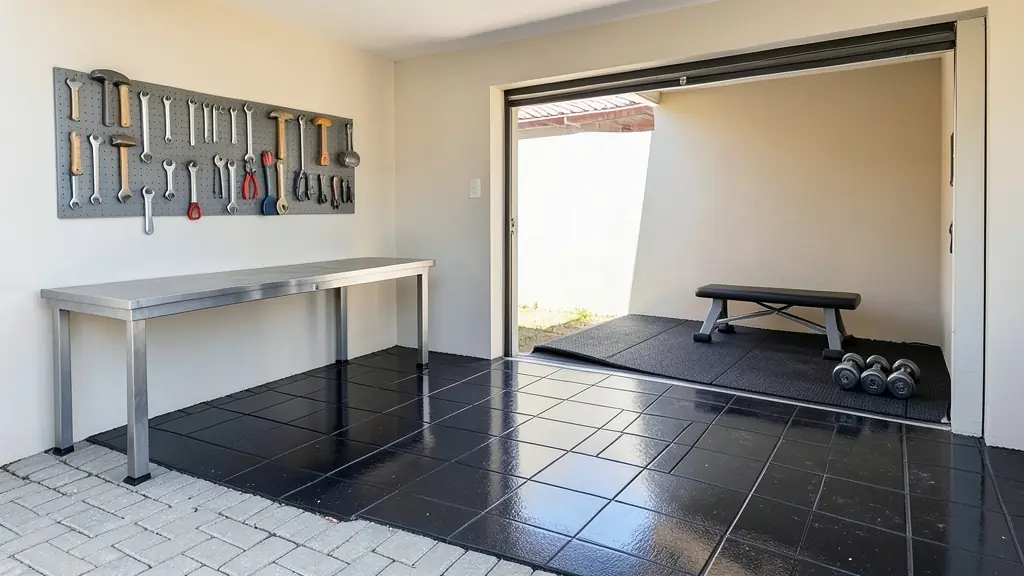
Garage flooring tiles take the chill and the dust off a bare slab, stop dropped tools from chipping it, and turn a garage into a usable workshop or home gym. Rubber tiles and mats are the most common choice, with PVC interlocking tiles as the main alternative. If a car parks on the floor, the tile has to be made for that: hot tyres, the weight of the car turning on the spot, and the odd drip of oil all test a garage floor. This page covers the options, cars on rubber, ramps and the door, and how to get quotes.
Rubber or PVC, tiles or mats
Rubber tiles are heavy, quiet, grippy and soft on dropped tools and knees. Interlocking rubber tiles are the easiest to lay yourself. PVC interlocking tiles are lighter, harder and shinier, come in more colours and wipe clean easily, but are louder and slipperier when wet. Loose rubber mats or matting off the roll under the car, the bench or the gym corner cover the spots that matter at a lower cost than tiling the whole floor. Epoxy coatings are another option, hard and easy to clean but cold and loud.
Cars on rubber
Not every rubber tile is made to be parked on. Ask for a tile the maker rates for vehicle traffic: dense, firmly joined and thick enough not to creep when tyres turn on it. Hot tyres can leave marks on some rubber, especially after a long drive in summer. Petrol, diesel and engine oil can swell and soften SBR rubber over time, so wipe spills promptly and put a drip tray or oil-resistant mat under a vehicle that leaks. Ask the supplier about oil resistance, and whether a nitrile-based mat suits the parking spot.
Ramps, the door and drainage
Tiles raise the floor by their thickness, so fit a bevelled ramp along the garage door and any doorway to the house, both to drive over and to stop trips. Check that the door still closes over the tiles and seals at the bottom. Garages that get water blown in under the door, or where you wash the car, need the slab's fall towards the door kept clear, or water sits under the tiles. Lay on a clean, dry slab, and let the tiles acclimatise first.
Workshop and home gym in the garage
For a workshop, put thicker, oil-resistant rubber in front of the bench where you stand for hours, or an anti-fatigue mat. For a gym corner, use 15 to 20 mm tiles and a thicker drop area for the barbell; see gym flooring. Keep the gym corner out of the car's wheel path.
What to put in your request
- The garage's length and width
- Whether a car parks on it, and how many
- What else happens there: workshop, gym or storage
- Rubber tiles, PVC tiles or mats
- How many doors need ramps
Garage Floor Tiles for gyms, schools, homes, industry and farms
- Gyms and fitness studios: small gyms and personal training studios run from garages
- Schools, crèches and play areas: school maintenance garages and groundskeeper sheds
- Homeowners: single and double garages used for parking, a workshop and a home gym
- Factories, mines and plants: vehicle bays, workshop floors and tool stores on bare slabs
- Shops, offices and entrances: car showrooms, valet bays and parking at small offices
- Hotels, lodges and restaurants: golf cart garages and maintenance workshops at lodges and hotels
- Municipalities, parks and sports clubs: fleet garages and fire station equipment rooms
- Hospitals, clinics and care homes: ambulance bays and hospital maintenance workshops
- Farms, stables and dairies: farm workshops and sheds where bakkies and tractors are serviced
Frequently asked questions
Do you sell or lay garage floor tiles yourselves?
No. We are a free quote request service. We pass your request to independent suppliers and installers in your area, who quote you directly. We make and lay nothing, and we do not test or rate tiles for cars: that comes from the maker.
Will oil damage rubber garage flooring?
It can. Oil, petrol and diesel soften and swell ordinary SBR rubber if they sit on it. Wipe spills, use a drip tray under a leaking engine, and ask the supplier for an oil-resistant tile or mat for the parking spot.
Rubber tiles or epoxy for a garage?
Epoxy is hard, shiny and easy to wipe, but cold, loud and slippery when wet unless it has a grit finish, and the slab must be prepared properly. Rubber is warmer, quieter and kinder to dropped tools and knees, and suits a gym. Some people do both: epoxy under the car, rubber in the gym corner.
Can I park on interlocking rubber tiles?
Only on tiles the maker rates for vehicles. Thin or soft interlocking tiles can creep and their joints open when tyres turn on them. Tell the supplier a car will park there, how heavy it is, and whether it turns in the garage, so they can offer a tile that stays locked.
Garage Floor Tiles by province and city
- Johannesburg
- Pretoria
- Centurion
- Midrand
- Sandton
- Randburg
- Roodepoort
- Krugersdorp
- Randfontein
- Germiston
- Boksburg
- Benoni
- Kempton Park
- Alberton
- Vanderbijlpark
- Vereeniging
- Durban
- Pinetown
- Pietermaritzburg
- Richards Bay
- Newcastle
- Ladysmith
- Gqeberha (Port Elizabeth)
- East London
- Kariega (Uitenhage)
- Mthatha
- Cape Town
- Bellville
- Paarl
- Stellenbosch
- George
- Worcester
- eMalahleni (Witbank)
- Middelburg
- Secunda
- Mbombela (Nelspruit)
- Rustenburg
- Brits
- Klerksdorp
- Potchefstroom
- Mahikeng
- Polokwane
- Tzaneen
- Kimberley
- Upington
- Bloemfontein
- Welkom
- Sasolburg