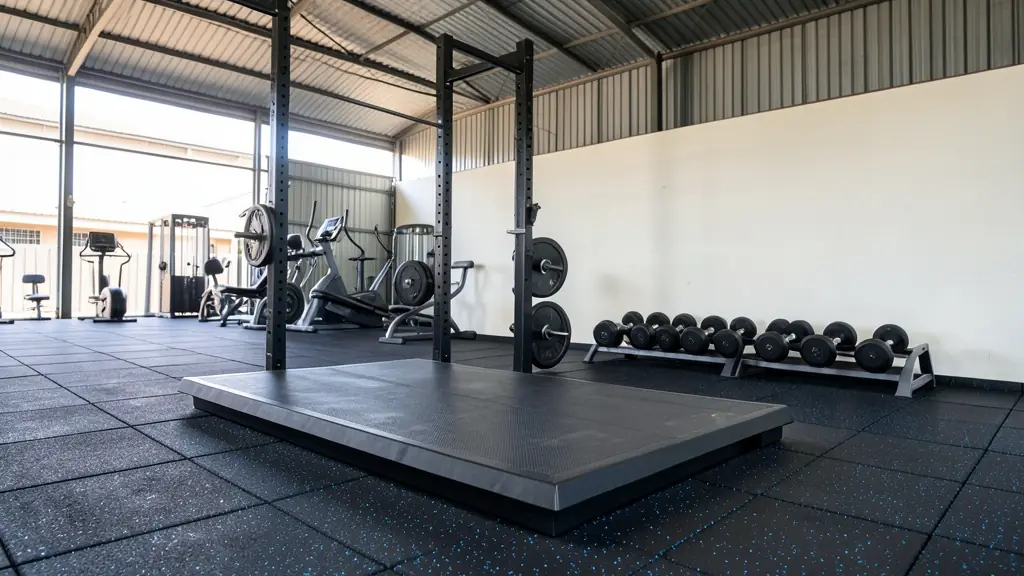
Search for gym mats and you get everything from foam yoga mats to 40 mm rubber tiles. For a gym floor, rubber is the standard: tiles or rolls that protect the slab and the equipment, damp the noise of dropped weights, cut vibration through the building and give grip when the floor is sweaty. This page is about rubber gym flooring for commercial and home gyms: how thick to go in each zone, drop zones and platforms, tiles against rolls, the smell question and cleaning. Then one request gets you quotes from suppliers and installers near you.
Thickness by zone
Do not buy one thickness for the whole gym. Under cardio machines and in stretching areas, about 6 to 10 mm rolls or tiles are enough. General training floors, with machines, benches and dumbbells, usually take 15 to 20 mm. Free weight areas where barbells are dropped need 30 to 40 mm or more, or a platform. Machines are the catch: very soft rubber dents under their feet, so choose a dense tile there. A floor plan marked in zones lets a supplier quote each area properly, and the maker's sheet tells you what each tile is meant to take.
Drop zones and platforms
Deadlifts and Olympic lifts put repeated shock into the slab, and the floor below in a first-floor gym. A drop zone uses the thickest tiles, sometimes doubled, or a platform: a timber or composite core with thick rubber on each side where the plates land. Some suppliers sell ready-made platforms; others build them from tiles. Ask what the platform is built to absorb, and whether the slab or suspended floor can carry it. Bumper plates help too; iron plates on any floor are hard on everything.
Tiles or rolls
Rolls cover big open floors with few joints and are quicker to lay; they are usually glued. Tiles let you mix thicknesses, replace a damaged piece and take the floor with you. Interlocking tiles suit home and garage gyms and rented spaces because they need no glue. Many commercial gyms use rolls across the floor and thicker tiles in the weights area, with ramps between levels so nobody trips.
Smell, noise and cleaning
Recycled SBR rubber has a smell that fades with airing; EPDM-topped or virgin rubber smells less, which matters in a small studio. Rubber cuts impact noise and vibration, but a first-floor gym or a shared wall may need a thicker floor or an acoustic underlay; ask the supplier. Clean with a pH-neutral cleaner and a mop or scrubber, and avoid solvents and oily products, which make rubber slippery and break it down.
What to put in your request
- The gym's floor area and a rough plan of the zones
- Where free weights are dropped, and how heavy
- Tiles, rolls or both, and the thicknesses you want
- Ground floor or upper floor
- Supply only or supply and installation
Gym Flooring for gyms, schools, homes, industry and farms
- Gyms and fitness studios: full fit-outs of commercial gyms, box gyms and studios, zoned by thickness
- Schools, crèches and play areas: school and university weight rooms and sports science labs
- Homeowners: garage and spare room gyms with a drop area for the barbell
- Factories, mines and plants: staff gyms at plants and mines, often in converted rooms
- Shops, offices and entrances: office gyms and wellness rooms in office parks
- Hotels, lodges and restaurants: hotel and lodge gyms that need a quiet, tidy floor
- Municipalities, parks and sports clubs: community gyms and sports centres run by the municipality
- Hospitals, clinics and care homes: physio and biokinetics practices with free weights and machines
- Farms, stables and dairies: farm house gyms in sheds and outbuildings on a bare slab
Frequently asked questions
Do you sell gym mats or install gym floors?
No. We are a free quote request service. We pass your request to independent gym flooring suppliers and installers who work in your area, and they quote you directly. We sell and lay nothing ourselves.
What flooring do I need for a garage gym?
For most home gyms, 15 to 20 mm rubber tiles over the whole floor, with a thicker drop area or platform if you deadlift. Interlocking tiles are easy to lay yourself. Add ramps at the open edges, and keep the tiles out of the path of the car or choose ones made for car traffic.
Will rubber flooring stop noise reaching the neighbours?
It helps a lot with impact noise, especially with thick tiles and bumper plates, but it does not make a gym silent. Airborne noise such as music needs other measures. On upper floors or in shared buildings, ask the supplier about thicker tiles or underlay.
Are foam gym mats the same as rubber gym flooring?
No. Foam exercise and yoga mats are for floor work and are soft and light. They tear and dent under weights and machines. Rubber gym flooring is denser, heavier and built to take equipment and dropped weights. Many gyms use both: rubber on the floor, foam mats on top for stretching and core work.
Gym Flooring by province and city
- Johannesburg
- Pretoria
- Centurion
- Midrand
- Sandton
- Randburg
- Roodepoort
- Krugersdorp
- Randfontein
- Germiston
- Boksburg
- Benoni
- Kempton Park
- Alberton
- Vanderbijlpark
- Vereeniging
- Durban
- Pinetown
- Pietermaritzburg
- Richards Bay
- Newcastle
- Ladysmith
- Gqeberha (Port Elizabeth)
- East London
- Kariega (Uitenhage)
- Mthatha
- Cape Town
- Bellville
- Paarl
- Stellenbosch
- George
- Worcester
- eMalahleni (Witbank)
- Middelburg
- Secunda
- Mbombela (Nelspruit)
- Rustenburg
- Brits
- Klerksdorp
- Potchefstroom
- Mahikeng
- Polokwane
- Tzaneen
- Kimberley
- Upington
- Bloemfontein
- Welkom
- Sasolburg