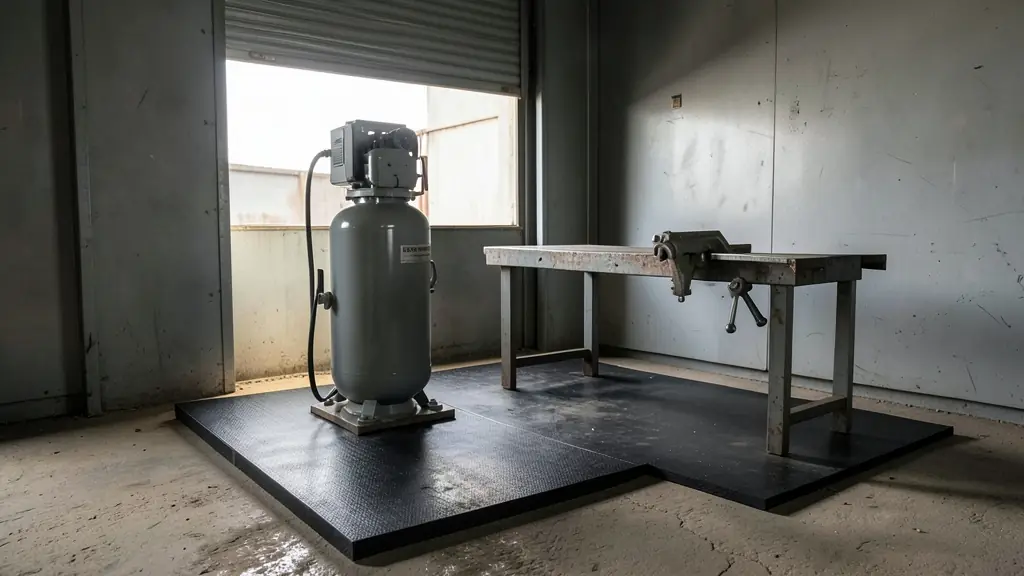
Heavy-duty rubber mats are thick solid or cloth-reinforced rubber made to sit under machines, take dropped steel and stand up to forklifts, boots and weather. They go under compressors and generators to cut vibration and noise, on loading bays and in steel yards to protect the slab, and in mine and plant workshops where thin mats tear in a week. Thickness, compound and size depend on what sits on them. This page explains the options and what to ask. Send one request and industrial mat suppliers in your area quote you directly.
Where industrial mats earn their keep
- Machine bases: under presses, compressors, pumps and generators to damp vibration and stop them walking.
- Workshops: in front of benches and lathes where tools and parts drop.
- Loading bays and steel yards: where bars, castings and crates are put down on concrete.
- Mine and plant workshops: change houses, wash bays and service pits.
- Heavy gyms: under lifting platforms (see gym flooring).
Conveyor belts, chute liners and wear linings are related products that some of the same suppliers make; mention them if you need them.
Thickness and construction
Heavy-duty mats are commonly from about 10 mm up to 30 mm or more. Solid rubber mats are dense and hard-wearing; insertion rubber has layers of cloth inside that stop tearing and stretching under point loads; bonded crumb mats are cheaper and softer, better for impact than for wheels and steel edges. A mat that is too soft lets a machine rock; one that is too hard does little for vibration. Tell the supplier the weight and footprint of the machine and they will suggest a mat. For big or fast machines, a mat may only be part of the answer; anti-vibration mounts or a separate plinth are matters for your engineer.
Compound for the conditions
Workshops with oil, diesel and hydraulic fluid need an oil-resistant rubber such as nitrile, because oil swells and softens ordinary SBR. Outdoors, EPDM or a UV-resistant compound lasts longer in the sun. Hot work areas need a rubber that will not soften or burn easily; ask about heat and fire performance. Near switchgear, ordinary black rubber is not enough: use rated electrical insulating mats.
Handling and fitting
These mats are heavy. A large thick mat can need two or more people or a forklift to move, so plan delivery and access. Cut with a sharp blade in several passes, or ask the supplier to cut to size. Under machines, the mat usually sits loose or is bolted through with the machine; in walkways, ramped edges stop trips and trolley snags. For thinner matting off the roll, see rubber matting.
What to put in your request
- How many mats and the size of each
- What sits on or crosses the mat, and its weight
- Oil, diesel, heat or sun exposure
- Thickness, if you know it
- Delivery access: forklift or tail-lift truck
Heavy-Duty and Industrial Rubber Mats for gyms, schools, homes, industry and farms
- Gyms and fitness studios: thick mats under lifting platforms, heavy dumbbell rows and machines
- Schools, crèches and play areas: solid mats under kilns, compressors and metalwork machines
- Homeowners: a thick mat under a compressor, generator or workshop bench
- Factories, mines and plants: mats under presses and pumps, in steel yards and mine workshops
- Shops, offices and entrances: mats under backup generators and at goods receiving bays
- Hotels, lodges and restaurants: mats under laundry machines, generators and cold room compressors
- Municipalities, parks and sports clubs: mats in pump stations, water works and depot workshops
- Hospitals, clinics and care homes: mats under generators, laundry machines and plant room equipment
- Farms, stables and dairies: mats in workshops, under milking machine pumps and on loading ramps
Frequently asked questions
Do you supply industrial rubber mats yourselves?
How thick should a mat under a machine be?
Can forklifts drive over heavy-duty rubber mats?
Will heavy-duty mats resist oil?
Heavy-Duty and Industrial Rubber Mats by province and city
- Johannesburg
- Pretoria
- Centurion
- Midrand
- Sandton
- Randburg
- Roodepoort
- Krugersdorp
- Randfontein
- Germiston
- Boksburg
- Benoni
- Kempton Park
- Alberton
- Vanderbijlpark
- Vereeniging
- Durban
- Pinetown
- Pietermaritzburg
- Richards Bay
- Newcastle
- Ladysmith
- Gqeberha (Port Elizabeth)
- East London
- Kariega (Uitenhage)
- Mthatha
- Cape Town
- Bellville
- Paarl
- Stellenbosch
- George
- Worcester
- eMalahleni (Witbank)
- Middelburg
- Secunda
- Mbombela (Nelspruit)
- Rustenburg
- Brits
- Klerksdorp
- Potchefstroom
- Mahikeng
- Polokwane
- Tzaneen
- Kimberley
- Upington
- Bloemfontein
- Welkom
- Sasolburg