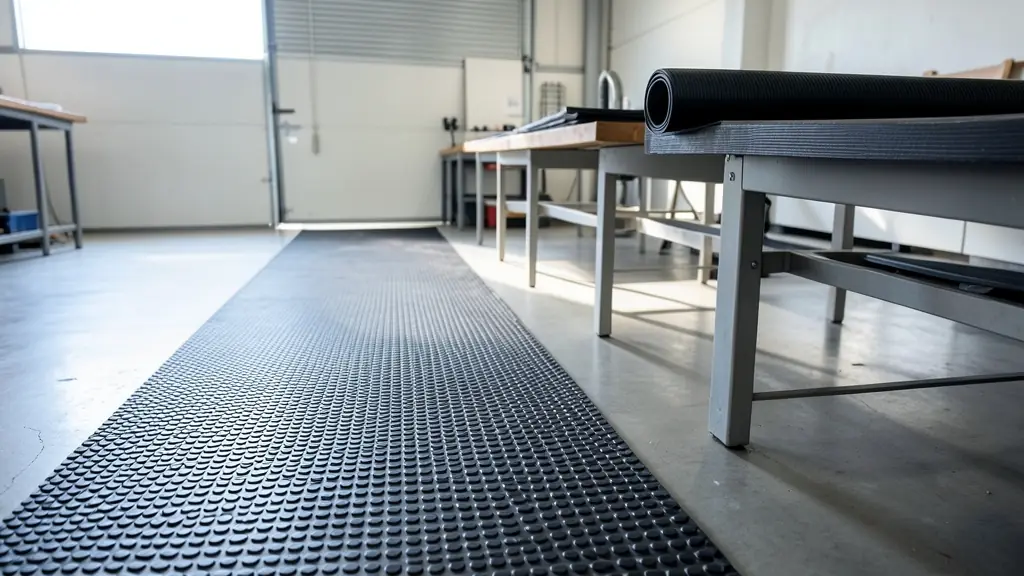
Rubber matting is rubber sheet sold off the roll, usually by the running metre, and cut to the length you need. It lines walkways, workbenches, counters, trailers, stairs and vehicle floors, and it comes in plain, coin, ribbed, chequer and diamond tops as well as cloth-reinforced insertion rubber. The right sheet depends on the compound, the thickness and what will be on it every day. This page explains the kinds, how matting is measured and what to tell a supplier. Send one request and matting suppliers who deliver in your area quote you directly.
Patterns and what each one is for
- Plain (flat) sheet for counters, bench tops, gaskets and general lining.
- Coin (raised dots) for walkways, reception areas and vehicle floors: grip in all directions and easy to sweep.
- Ribbed or fluted for ramps, passages and trailer floors, with the ribs laid across the direction of travel.
- Chequer and diamond for stair treads, workshop floors and loading areas.
- Insertion rubber, which has layers of cloth inside, for industrial sheeting that must not stretch or tear easily.
For wet or greasy floors, see non-slip rubber matting.
Compounds: not all black rubber is the same
Matting is made from different rubbers, and the compound matters more than the colour. Natural rubber is tough and springy. SBR is the common general-purpose grade. Nitrile resists oil and fuel, so it suits workshops and engine rooms. Neoprene handles weather and some chemicals, and EPDM stands up well to sun and ozone outdoors. If oil, diesel, acids or strong sunlight will reach the matting, say so in your request and ask the supplier which compound they recommend.
Widths, thickness and ordering by the metre
Rolls are commonly about 1 to 2 m wide, and thickness starts at about 3 mm for light lining and goes up to thick sheet for heavy wear. You order a width and a number of running metres: a passage 1.2 m wide and 14 m long needs 14 running metres of a 1.2 m roll, plus a little for trimming. Many suppliers cut to length; some will cut shapes or punch holes for a fee. Rubber is heavy, so ask about the roll weight and delivery. For thick gym and floor rolls, see rubber flooring rolls.
Laying and looking after it
Let the matting lie flat in the room for a day so the curl from the roll relaxes. Lay it on a clean, dry, flat surface, trim with a sharp blade against a straight edge, and glue the ends or fit an edge strip where people walk on and off it. Wash it with water and a pH-neutral cleaner; solvents and harsh degreasers can swell or crack some compounds. Where heavy machines stand, look at heavy-duty rubber mats instead.
What to put in your request
- The width and length of each area, or running metres
- The pattern you want: plain, coin, ribbed, chequer
- The thickness, or what goes over the matting
- Whether oil, chemicals or sun will reach it
- Cut to size or full rolls, and the delivery address
Rubber Matting for gyms, schools, homes, industry and farms
- Gyms and fitness studios: rolled matting along change room passages and under benches and storage
- Schools, crèches and play areas: coin matting in corridors, laboratories and workshop classrooms
- Homeowners: ribbed matting on garage benches, trailer floors and the back stoep
- Factories, mines and plants: insertion and nitrile sheet for workbenches, walkways and machine guards
- Shops, offices and entrances: coin matting at entrances, behind counters and on stair treads
- Hotels, lodges and restaurants: matting in cold rooms, bottle stores and service passages
- Municipalities, parks and sports clubs: ribbed sheet for ramps, pump stations and depot workshops
- Hospitals, clinics and care homes: plain sheet on workshop benches and coin matting in service corridors
- Farms, stables and dairies: ribbed matting in trailers, packhouses and dairy passages
Frequently asked questions
Do you sell rubber matting yourselves?
How do I work out how much matting to order?
What thickness of rubber matting do I need?
Will rubber matting smell?
Rubber Matting by province and city
- Johannesburg
- Pretoria
- Centurion
- Midrand
- Sandton
- Randburg
- Roodepoort
- Krugersdorp
- Randfontein
- Germiston
- Boksburg
- Benoni
- Kempton Park
- Alberton
- Vanderbijlpark
- Vereeniging
- Durban
- Pinetown
- Pietermaritzburg
- Richards Bay
- Newcastle
- Ladysmith
- Gqeberha (Port Elizabeth)
- East London
- Kariega (Uitenhage)
- Mthatha
- Cape Town
- Bellville
- Paarl
- Stellenbosch
- George
- Worcester
- eMalahleni (Witbank)
- Middelburg
- Secunda
- Mbombela (Nelspruit)
- Rustenburg
- Brits
- Klerksdorp
- Potchefstroom
- Mahikeng
- Polokwane
- Tzaneen
- Kimberley
- Upington
- Bloemfontein
- Welkom
- Sasolburg