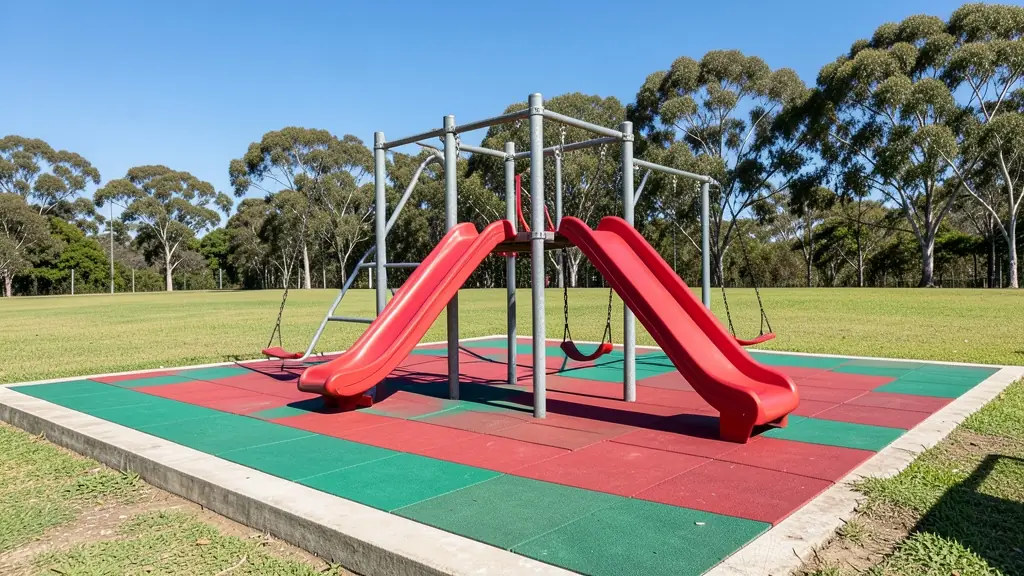
Playground rubber tiles are thick, impact-absorbing safety tiles laid under and around play equipment. They are tested to show how high a fall they can cushion, and the right thickness depends on how high children can fall from the equipment above. Schools, crèches, municipalities, restaurants, lodges and families with a backyard jungle gym use them because they stay put, drain, and do not get kicked away like sand or bark. This page explains fall height and testing, the area to cover, the base underneath and your options, then how to get quotes.
Fall height and EN 1177
The European standard EN 1177 sets how impact-attenuating playground surfaces are tested, using the head injury criterion (HIC). The result is a critical fall height: the height a given surface, at a given thickness, was tested for. EN 1176 covers the equipment itself. Ask every supplier for the maker's test certificate showing the critical fall height for the exact tile and thickness offered, and match it to the free height of fall of your equipment, the highest point a child can stand or sit. A thicker tile usually covers a higher fall. No surface makes a fall safe; it reduces the risk of serious injury.
Cover the whole impact area
Children do not fall straight down. They jump off swings, slide off the side and tumble off climbing frames. The surface must extend around the equipment, further for swings and higher frames, and the equipment maker or a playground supplier can tell you the impact area for each piece. Tiles laid only under a frame, with grass or paving around, leave the hard edge exactly where children land. Sketch the equipment with measurements and let the supplier work out the area.
The base underneath
Lay on a firm, drained base: concrete, paving, or compacted crusher run with a slight fall so water runs off. Tiles on soft soil or sand rock, sink and open at the joints, and puddles under them grow mould. Edges should be restrained or ramped so they cannot curl into a trip. Tiles are glued or pinned to each other and the base, following the maker's system. For a large area or a municipal job, an installer with playground experience is worth the cost; see installation.
Tiles, grass mats or poured
Tiles are quick, replaceable and good on an existing slab. Rubber grass mats, with holes the grass grows through, suit low equipment on lawns where a green look matters, but check their tested fall height. A joint-free poured EPDM wetpour surface can be shaped around trees and curves and coloured in patterns. For splash pads and pool areas, see outdoor rubber tiles.
What to put in your request
- Each piece of equipment and its highest standing point
- The area around the equipment, with measurements
- The base now: lawn, sand, paving or concrete
- Colours you want, if any
- Whether you need the base prepared and the tiles laid
Playground Rubber Tiles for gyms, schools, homes, industry and farms
- Gyms and fitness studios: outdoor kids' play areas at family gyms and sports clubs
- Schools, crèches and play areas: foundation phase playgrounds, crèche yards and ECD centre jungle gyms
- Homeowners: a soft, tidy surface under a backyard jungle gym or swing set
- Factories, mines and plants: creche play areas at large plants and on mine villages
- Shops, offices and entrances: play areas at shopping centres, garden centres and office parks
- Hotels, lodges and restaurants: kids' play areas at restaurants, lodges and wedding venues
- Municipalities, parks and sports clubs: public park playgrounds and community centre play areas
- Hospitals, clinics and care homes: outdoor play areas at children's hospitals and therapy centres
- Farms, stables and dairies: play areas at farm stalls, pick-your-own farms and agri-tourism venues
Frequently asked questions
Do you supply or certify playground tiles?
No. We are a free quote request service. We pass your request to independent playground tile suppliers and installers in your area, who quote you directly. We do not test or certify any surface: the test certificate comes from the maker, and you should ask for it.
Is a rubber playground surface a legal requirement?
We do not say it is. Schools, crèches, municipalities and their insurers commonly ask for an impact-absorbing surface tested to EN 1177 under equipment, and many tenders specify it. Check what your own department, municipality or insurer asks for.
How thick should playground rubber tiles be?
It depends on the fall height. Low equipment for toddlers may need about 30 mm; taller frames need 40 mm, 50 mm or more. Use the maker's certificate for the tile you are buying, not a general rule, and match it to the equipment's free height of fall.
Can I put playground tiles on grass or sand?
Not directly. Grass and sand are not a firm base, so tiles move and sink. Lift the turf, compact a crusher run base with a fall, or use a slab. Rubber grass mats are the exception, made to sit on a lawn.
Playground Rubber Tiles by province and city
- Johannesburg
- Pretoria
- Centurion
- Midrand
- Sandton
- Randburg
- Roodepoort
- Krugersdorp
- Randfontein
- Germiston
- Boksburg
- Benoni
- Kempton Park
- Alberton
- Vanderbijlpark
- Vereeniging
- Durban
- Pinetown
- Pietermaritzburg
- Richards Bay
- Newcastle
- Ladysmith
- Gqeberha (Port Elizabeth)
- East London
- Kariega (Uitenhage)
- Mthatha
- Cape Town
- Bellville
- Paarl
- Stellenbosch
- George
- Worcester
- eMalahleni (Witbank)
- Middelburg
- Secunda
- Mbombela (Nelspruit)
- Rustenburg
- Brits
- Klerksdorp
- Potchefstroom
- Mahikeng
- Polokwane
- Tzaneen
- Kimberley
- Upington
- Bloemfontein
- Welkom
- Sasolburg