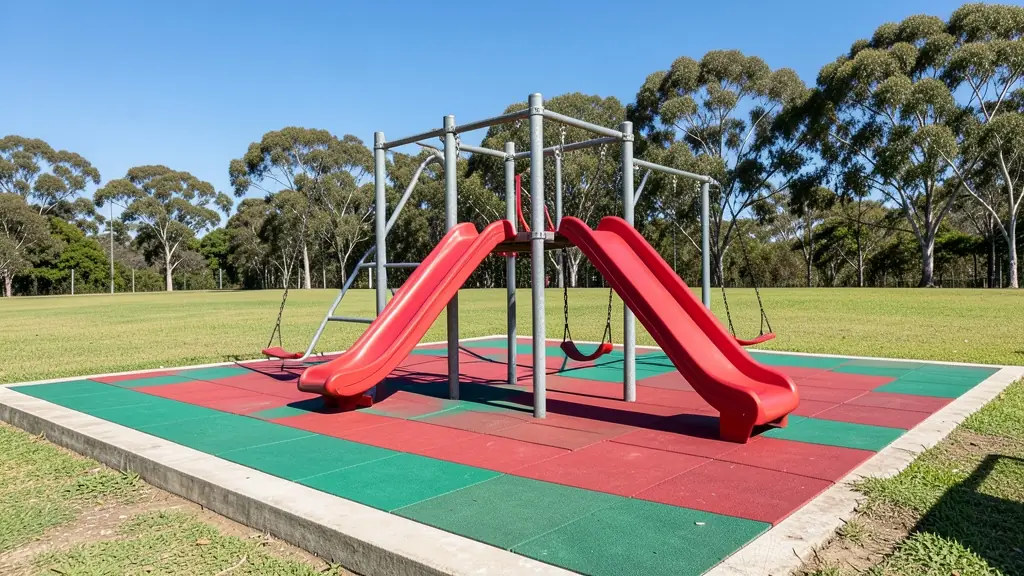
Under play equipment, the safety surface has to do two things: absorb a fall from the highest point a child can fall from, and reach far enough around the equipment to catch them. The European play standards, EN 1176-1 for equipment and EN 1177 for surfacing, set both. This calculator applies their general impact area rule; ask each supplier which standard their test certificate follows.
The rule the calculator uses
- Where the free height of fall is over 600 mm, the ground under and around the equipment needs an impact absorbing surface with a sufficient critical fall height (CFH): at least the free height of fall.
- That surface must cover the whole impact area.
- For a free height of fall from 0.6 m to 1.5 m, the impact area reaches 1.5 m beyond the equipment on every side.
- From 1.5 m to 3 m it grows in step with the height, to about 2.5 m at 3 m (two thirds of the height plus 0.5 m).
- The reach is measured from anything a child can fall from, including chains and ropes at full stretch.
Swings, slides, carousels and rocking equipment have their own impact areas in the standard, often longer in the direction of movement. For those, and for anything over 3 m, use the plan that comes with the equipment.
Thickness comes from the test, not a rule of thumb
Critical fall height is measured by dropping a test head onto the surface (EN 1177) and recording the impact. Each tile or poured system is tested at a set thickness, so a 40 mm tile from one maker may be rated for a different height than a 40 mm tile from another. Ask every supplier for the test certificate that shows the CFH at the thickness they quote, and check it is at least your free height of fall. For poured surfaces, ask for the thickness of the shock layer and the EPDM wear layer separately: see poured EPDM wetpour.
Several units on one play area
The calculator multiplies one unit's area by the number of units, as if each has its own surface. Where units stand close together the impact areas may overlap (only where the standard allows), so the real area can be smaller: draw the site plan with each unit's impact area and give it to the suppliers. Keep paths, benches and fences out of the impact areas.
Tiles or poured rubber
Playground rubber tiles are quick to lay on a firm, drained base and easy to replace one at a time. Poured EPDM has no joints, follows curves and slopes, and can carry patterns, but needs a contractor and dry weather. The tile count here is the grid for the impact area plus 7% for cuts; poured surfaces are priced by the area.