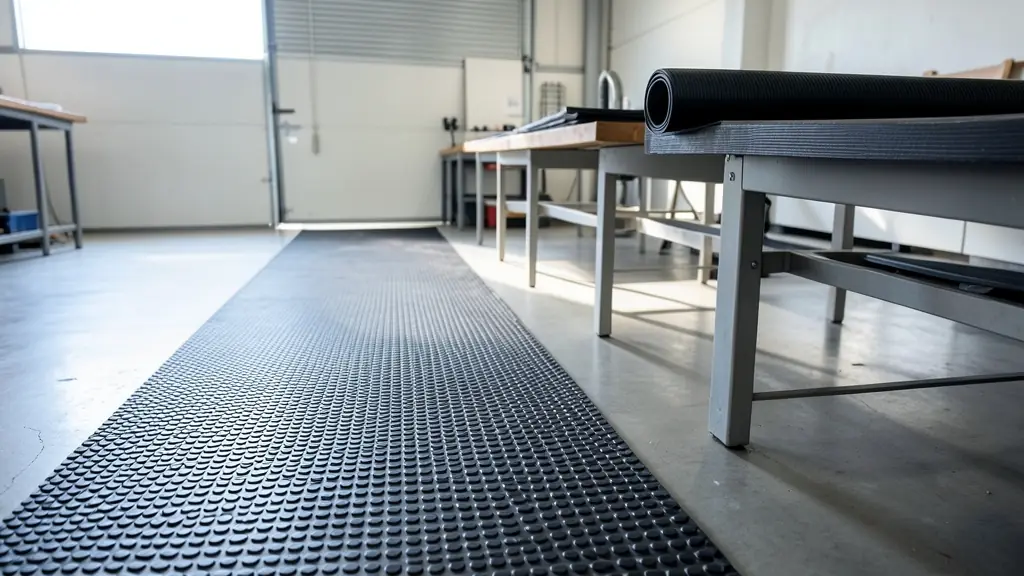
Rubber matting, non-slip ribbed or chequer matting, insulating matting and rubber flooring rolls come off a roll of a fixed width and are sold by the running metre. The width you choose decides how many strips you need, where the joins fall and how much is cut off the last strip. This calculator tries both directions and finds the one that wastes least.
Running metres, strips and joins
A running metre is one metre off the roll at its full width. A floor 3 m wide and 10 m long in 1.2 m matting needs three strips of 10 m: 30 running metres, 36 m² bought for 30 m² of floor, with the last strip cut down by 0.6 m. Run the same matting across the width and it needs nine strips of 3 m, 27 running metres but eight joins. Fewer joins look better and trip less; fewer metres cost less. The calculator shows both choices through the "Run the strips" setting.
Rolls and offcuts
Most suppliers cut to the length you ask for, so you pay for running metres. If you buy whole rolls, the calculator counts how many strips each roll gives and how many rolls that takes. A strip longer than the roll needs an end join. Keep the offcut: a strip of matting is useful at a door or under a bench.
Choosing the matting
- Rubber matting: general purpose, ribbed, coin or ring mat profiles, thin for walkways and thick for impact.
- Non-slip matting: wet areas, kitchens, ramps and walkways; ask for the slip rating.
- Rubber flooring rolls: 6 to 10 mm sports and gym rolls, glued or loose laid.
- Electrical insulating matting: in front of switchboards; choose by the voltage class on its test certificate.